Customer app
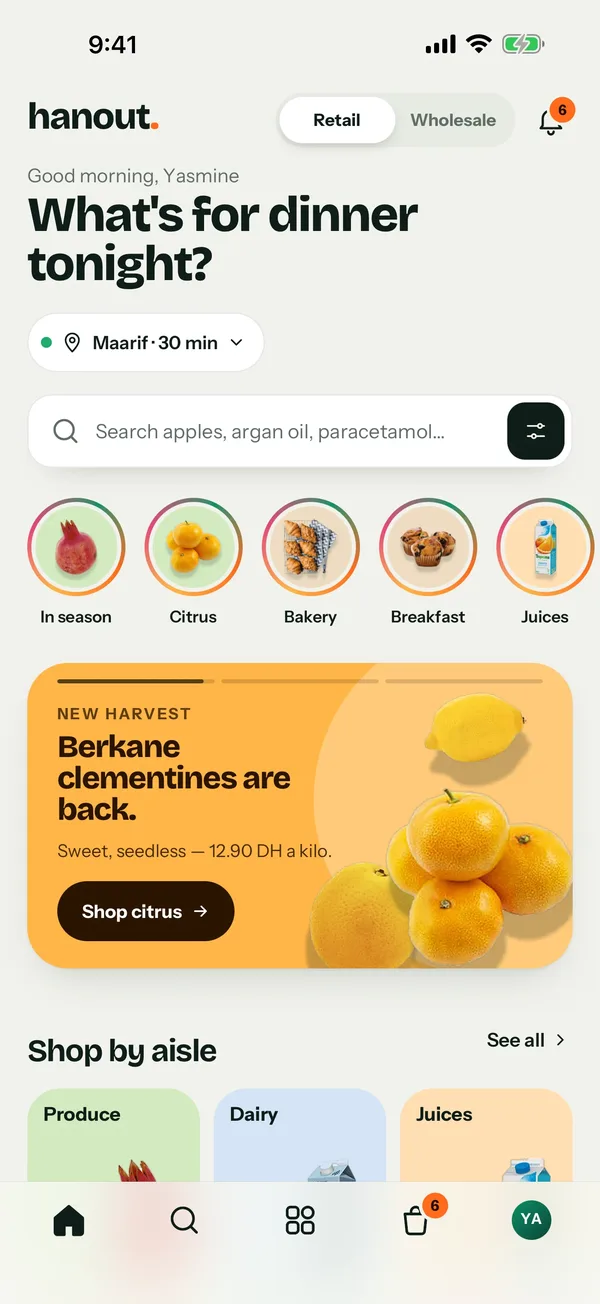
Browse by store and aisle, cart, delivery slot, cash or card payment, tracking to the door, then a rating. Tracking follows the flow we designed for hanout: confirmed, being prepared, on the way, delivered.
Service · On-demand delivery · Morocco
From our offices in Casablanca, Rabat and Marrakech, we design and build on-demand delivery apps for Morocco: a customer app, a courier app, a merchant portal and a dispatch back office, in French and Arabic. We handle what makes this kind of service work here: cash on delivery and courier cash, delivery zones and fees, live tracking. A mobile MVP typically takes 10 – 16 weeks; the full platform is quoted after a free discovery call.
Start a project →See pricing →
A Glovo-style app is a system: three interfaces and a back office following the same order in real time. Every missing piece ends up as phone calls.
Browse by store and aisle, cart, delivery slot, cash or card payment, tracking to the door, then a rating. Tracking follows the flow we designed for hanout: confirmed, being prepared, on the way, delivered.
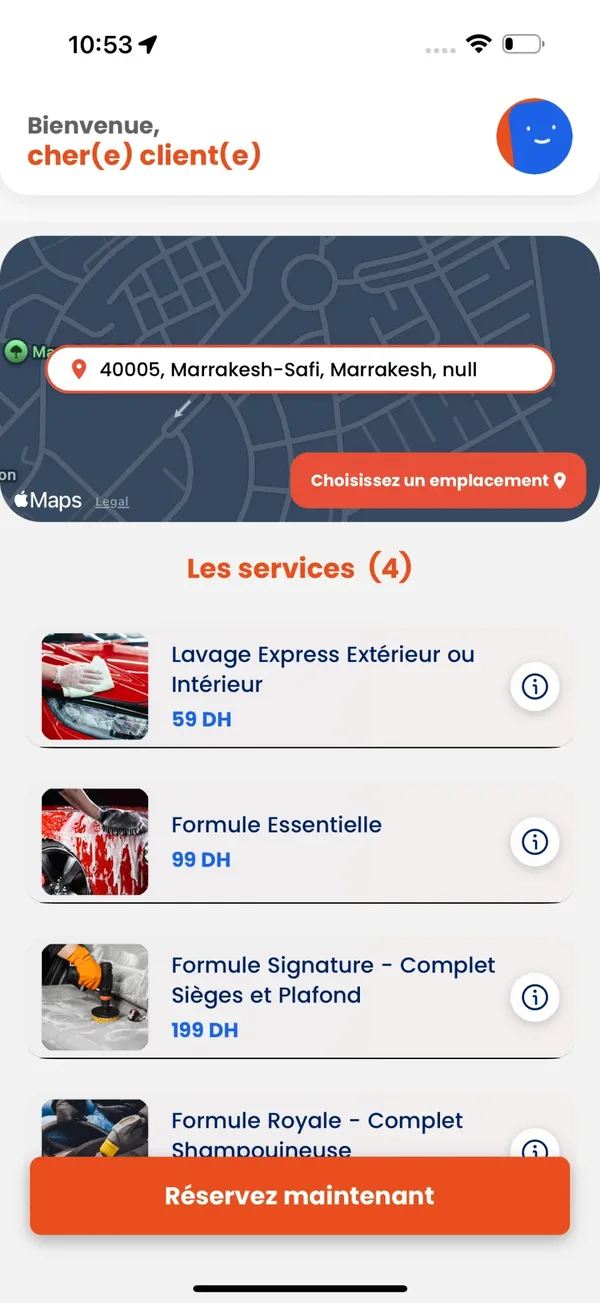
Go online, receive a job with the address and order details, accept, navigate, call the customer, confirm handover and payment. The same logic as WashMinute’s washer app, applied to meals, groceries and parcels.
Accept orders, flag out-of-stock items, set opening hours and prep times, track sales and payouts. For a first version, a web interface on a tablet is often enough.
Live orders, courier assignment, zones and fees, each courier’s cash, merchants, promotions, support and refunds. As with Cardnd’s agency portal and back office, everyone works from the same data.
According to ANRT’s ICT survey (2024 data), 84.1% of people who shop online in Morocco pay cash on delivery. In a delivery app, a large share of the money is likely to pass through your couriers’ pockets before it reaches you. That flow has to be designed from day one; patched later with a spreadsheet, it turns into discrepancies and disputes.
The courier sees the exact amount, and the customer can say at checkout which bill they’ll pay with. Each confirmed collection is time-stamped and geotagged.
Every courier has a live balance: what they collected, what they owe you, what you owe them. Above a limit you set, they stop receiving cash orders.
At the end of the day, the courier drops off the cash or makes a bank deposit. The back office matches expected against received, and every gap stays tied to a specific order.
Each merchant’s statement builds itself: sales, commission, delivery fees, returns. You pay on the agreed schedule, order by order.
Card payments (CMI, NAPS or Stripe) can be offered from day one: they reduce the cash in circulation, but they won’t eliminate it.
Automating dispatch too early is expensive and locks in rules you don’t know yet, so dispatch levels up with your volume. Tracking, on the other hand, ships on day one: courier position, ETA and status, for the customer and your team alike. In WashMinute, the customer already sees who is coming, and when.
| Level | How it works | When |
|---|---|---|
| Manual | An operator sees orders and couriers on a map and assigns each job. | Launch, low volume |
| Offer | The job goes to the nearest available courier; with no answer in time, it moves to the next one. | When the operator becomes the bottleneck |
| Automatic | Rule-based assignment: distance, workload, prep time, batching nearby orders. | Several zones, steady volume |
Version one has to prove two things: customers order again, and each delivery covers its costs. Everything else can wait.
| Part | Version 1 | Later |
|---|---|---|
| Customer | Catalog, cart, cash on delivery, tracking, rating | Loyalty, wallet, scheduled orders |
| Courier | Jobs, navigation, cash collection, balance | Order batching, bonuses |
| Merchant | Web portal: orders, out-of-stock items, hours | Dedicated app, analytics, POS integration |
| Back office | Manual dispatch, zones and fees, cash settlement, support | Automatic dispatch, multi-city, advanced promotions |
| Payments | Cash, plus card if your customers ask for it | Tips, delivery subscriptions |
Meals, groceries or parcels: each has its own hours, basket size and constraints. Start with the one you know best.
Sign merchants and train couriers before you open the app. A customer who finds an empty catalog doesn’t come back.
A few well-covered neighborhoods beat a whole city served late.
Average delivery time, cancellations, repeat orders, cost per delivery, cash gaps: once those numbers hold, add a zone, then a category, then a city.
Our mobile apps start at 30,000 MAD. A delivery platform combines several apps and a back office, so it’s priced on a custom quote, with a detailed proposal after discovery and several options if your budget calls for it. The price depends mainly on:
Also budget for running costs: hosting, app store developer accounts, usage-based maps and SMS, payment provider fees, maintenance.
Real projects, with their screens and their status.
Our mobile apps start at 30,000 MAD; a full platform (three interfaces and a back office) is priced on a custom quote. The biggest lever is what goes into version one: a web merchant portal and manual dispatch bring the bill down. The detailed proposal follows the discovery call.
A mobile MVP typically takes us 10 – 16 weeks; the schedule for a full platform is set after discovery. Recruit merchants and couriers during development, not after.
Not at first. The customer and courier apps are mobile apps; the merchant portal can start as a web app on a tablet, and the back office runs on the web too. With React Native and Expo, each app ships to iOS and Android from a single codebase, with over-the-air updates.
Yes: card payments through CMI, NAPS or Stripe alongside cash on delivery, with amounts and commissions calculated server-side. WashMinute already offers both, card via NAPS or cash on delivery.
Yes. Employees, freelancers or a partner fleet: only the pay and balance rules change in the back office. Courier status is a labor and tax question, though, so have it reviewed by a legal advisor before launch.
Yes. We start with a code and infrastructure audit, then propose a plan: add the courier app and dispatch to your product, or rebuild the part that’s holding you back.
You do: code, designs and intellectual property are handed over with documentation and access. We sign an NDA before discussing details. After launch, we can maintain the product with a monthly report, or you can take it in-house.
Tell us your city, your category and how your couriers work. We reply within 24 hours to set up a free discovery call, then send you a detailed proposal.