Customer journey
Search, compare, book, pay, track, rate. On mobile, on the web, or both, like Cardnd.
Service · Multi-sided platforms · Morocco
We design and build marketplaces that connect customers with service providers in Morocco: vehicle rentals, home services, garages, delivery. A marketplace is really three connected products (the customer app, the partner portal and the operations back office) plus the rules for money and trust that hold them together. Every project is custom-quoted after a free discovery call with our team in Casablanca, Rabat or Marrakech.
Start a project →See pricing →
The customer only sees one app. Behind it, two other audiences are working at the same time, and all of them need to read the same data, to the second. On Cardnd, a booking accepted by the agency shows up instantly on the traveler’s side.
Search, compare, book, pay, track, rate. On mobile, on the web, or both, like Cardnd.
Agency, garage, washer or courier: manage listings, availability and prices, accept or decline requests, track earnings.
Your team approves partners, moderates, handles disputes and support, and runs the business with a CRM.
APIs, real-time updates and pricing logic in one place, so an amount or a status never differs from one interface to another.
A marketplace sells trust first. The customer pays someone they don’t know; the provider accepts a customer they’ve never met. Here’s what we build to reduce that risk:
This is the trickiest part, and the one generic quotes leave out. Every dirham has to be traceable: what the customer paid, what goes to the partner, what the platform keeps, and when. All of these calculations run on the server, never in the app.
Cash can’t be bolted on at the end: according to ANRT’s ICT survey (2024 data), reported by Hespress, 84.1% of online shoppers in Morocco pay cash on delivery.
| Flow | How we handle it | Example |
|---|---|---|
| Deposit | Part paid online at booking, the balance on site, every amount explained before payment | Cardnd: card deposit, balance at vehicle handover |
| Commission | Calculated on each transaction and shown to the partner before they accept | Cardnd: commission and profit shown on every request |
| Online payment | CMI, NAPS or Stripe, depending on your company setup and your customers | WashMinute: card via NAPS |
| Cash | The partner collects; the platform records the commission owed, deducts it from upcoming online payments or bills it on a fixed date | WashMinute: cash on delivery available |
| Payouts | A balance per partner, a detailed statement and transfers on a set schedule | Cardnd: earnings tracked in the agency portal |
There are two ways to book, and the choice changes the product. On-demand services add a third question: dispatch.
The customer sends a structured request; the partner accepts or declines in one tap. That’s the Cardnd model: safer when supply changes fast, like a rental fleet.
The slot is confirmed right away. Smoother for the customer, but it demands reliable calendars and strict protection against double bookings.
The job goes out to available providers. On WashMinute, the washer sees the location, distance and estimated route before accepting.
Partners open their slots, block time off and set their prices; the platform only shows what can actually be served.
A marketplace’s first risk isn’t technical: it’s opening with customers and no providers, or the other way around.
Start where you can recruit the first partners yourself, with a single type of service. Expanding later costs little if the architecture plans for it.
Recruit and vet partners before opening to the public, so the first customer finds a real choice.
Dispatch, approvals or payouts can start partly by hand from the back office. Automate when volume justifies it.
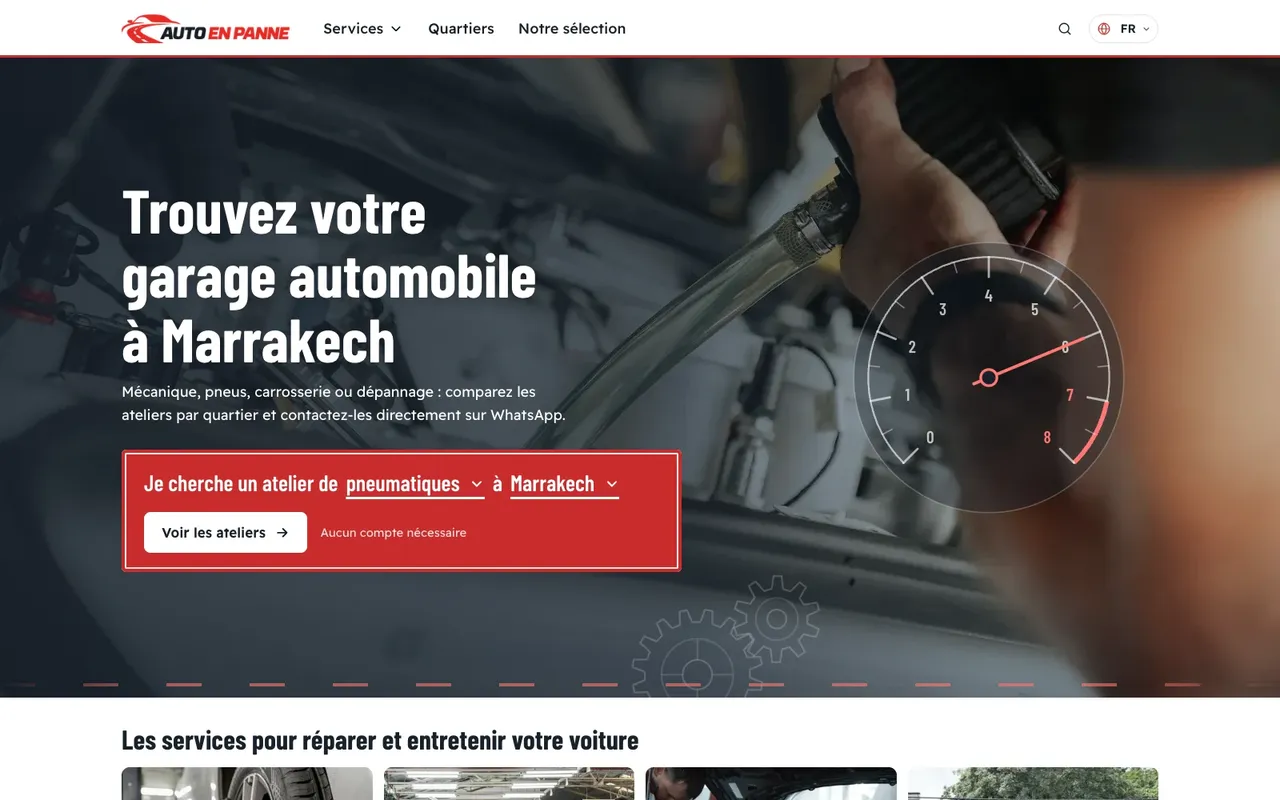
You can start with a simple contact request, like Auto En Panne’s WhatsApp contact, then add payments and commissions.
Request acceptance rate, partner response time, repeat bookings: these numbers tell you where to invest the next sprint.
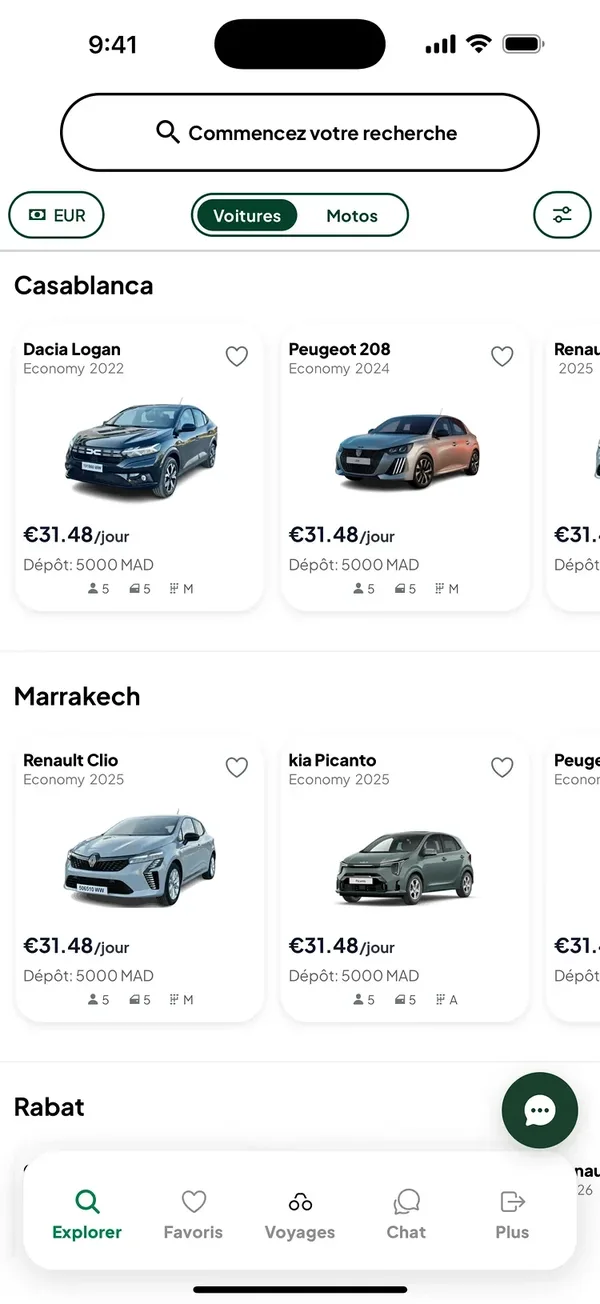
Cardnd connects travelers with local agencies, for cars and motorbikes alike, from search to returning the keys. In production on iOS and Android.
Auto En Panne, in Marrakech: search by service and neighborhood, workshop profiles, WhatsApp contact and a full back office, in French, Arabic and English.
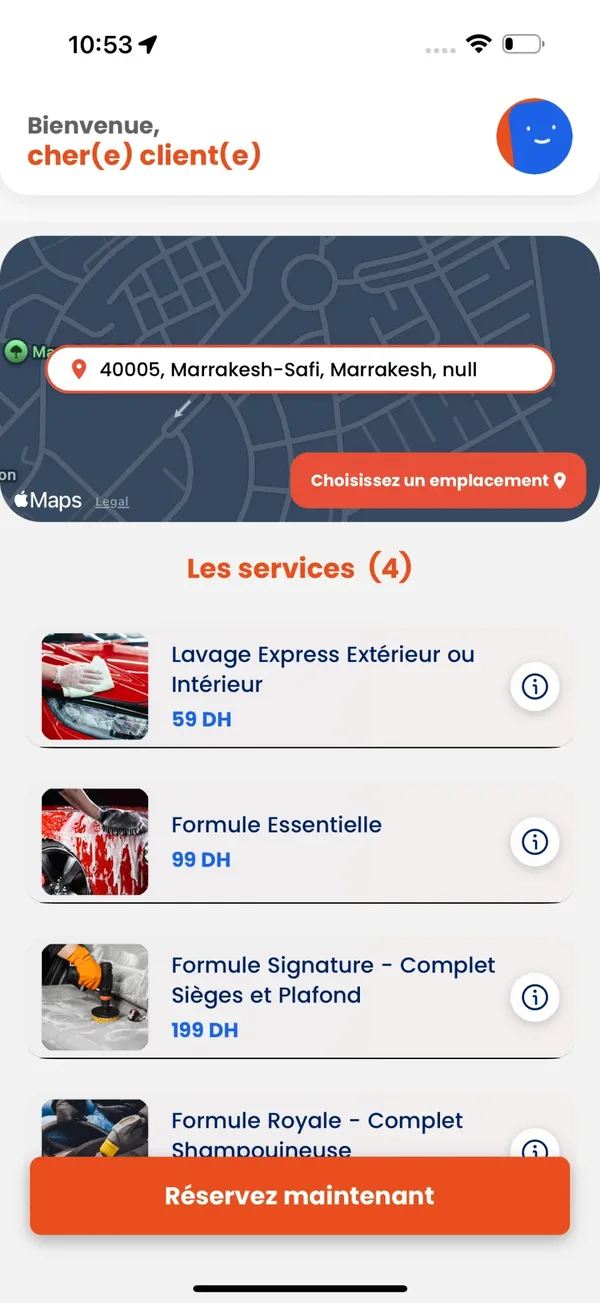
WashMinute: the customer books a wash and drops a pin on the map, and the job goes to a washer who has an app of their own.
Customer app, courier app, merchant portal and dispatch. For customer-side tracking, hanout (launching soon) shows every step: confirmed, being prepared, on the way, delivered.
Rider app, driver app and admin. In Morocco, the legal framework comes before the code: we design the platform so it can run with licensed operators (taxis, fleets, staff transport…) and recommend legal advice before launch.
Tours and activities: time slots, number of participants, deposits and reviews. The same foundation as rentals, with a calendar per activity.
A marketplace is always custom-quoted. For reference, our mobile MVPs typically take 10 to 16 weeks and our complex web platforms 12 to 20 weeks; a marketplace often combines both, and the exact schedule is set after discovery.
After launch, a marketplace roadmap changes every week. That’s why a dedicated team, billed monthly, is often the best fit at that stage: priorities change, and the team adapts.
Real projects, with their screens and their status.
It’s custom-quoted. The price depends on the number of interfaces (customer app, partner portal, back office), the money flows (deposits, commissions, cash, payouts) and how much is automated at launch. After a free discovery call, you receive a detailed proposal, with several options if your budget calls for it.
It depends on how often people use it. A customer who comes back often (groceries, car washes) justifies an app; a one-off need, like finding a garage, works well on the web, as with Auto En Panne. Cardnd combines an iOS and Android app, an agency portal, a back office and a website.
The partner collects the money; the platform records the commission owed on the partner’s balance. It’s deducted from upcoming online payments or settled on a fixed date, with a detailed statement. Above an unpaid threshold, new requests for that partner can be paused.
Carefully. According to an Interior Ministry statement reported by Hespress in April 2025, only licensed taxis are authorized to provide urban transport through ride-hailing apps, and a framework for ride-hailing platforms is under study. We design the platform so it can run with licensed operators (taxis, fleets, staff transport…) and recommend legal advice before launch; our ride-hailing page covers these cases.
Yes, as long as the data model plans for it from the start. Cardnd shows available vehicles city by city and prices in MAD or EUR. We still advise launching in a single city: it’s the architecture that should be ready for what comes next, not the launch.
Describe your two audiences and what happens between them. We reply within 24 hours to set up a free discovery call, under NDA.