Licensed taxi operators and fleets
In-app booking, assignment to the nearest available taxi, live tracking, trip history and stats per vehicle and per driver.
Service · Ride-hailing & taxi · Morocco
From our offices in Casablanca, Rabat and Marrakech, we design and build inDrive-style ride-hailing and taxi apps: a rider app, a driver app and a back office, with calculated fares or negotiated offers, live tracking, cash or card. In Morocco, according to the Interior Ministry position reported by Hespress in April 2025, only licensed taxis may provide urban passenger transport, so we design the platform so it can run with licensed operators (taxis, fleets, staff transport…) and recommend legal advice before launch. Projects are quoted individually; a mobile MVP typically takes 10 – 16 weeks.
Start a project →See pricing →
According to Hespress, in April 2025 the Interior Ministry maintained its position: licensed taxis are the only legitimate operators of urban passenger transport, including when rides are booked through a ride-hailing app. The minister told Parliament that studies are underway to draw up a suitable regulatory framework, with no set date.
As things stand, a service where private individuals carry passengers in their own cars falls outside the framework the ministry described. We’re not lawyers: before committing a budget, have your model reviewed by a lawyer, then check again at launch, because the rules may change. Questions to ask:
This section summarizes a press report; it is not legal advice.
In every case, the platform is designed to run with an operator that holds the authorizations its service requires; the app runs that service.
In-app booking, assignment to the nearest available taxi, live tracking, trip history and stats per vehicle and per driver.
Company shuttles: routes, schedules, pickup points, passenger lists and tracking for HR or the operator.
Routes, boarding and drop-off check-ins, vehicle location and notifications for parents, with access restricted to the school.
Airport, hotel, excursions: advance booking, price known at checkout, drivers from an authorized carrier, interface in French, English and Arabic.
With offices in Morocco and Ottawa, we also build for other countries, each with its own transport rules, currency and payment providers.
The rider app, the driver app and your team’s back office follow the same ride in real time.
The rider sets pickup and drop-off on the map, picks a vehicle type, then sees an estimate or names a price.
The request goes to nearby drivers who are online and approved. In inDrive mode, they accept or counter; the rider chooses by price, rating and arrival time.
Driver location, ETA, car model and plate. Calls or messages without exposing personal numbers.
Turn-by-turn navigation for the driver, trip sharing with a contact, an SOS button linked to your team.
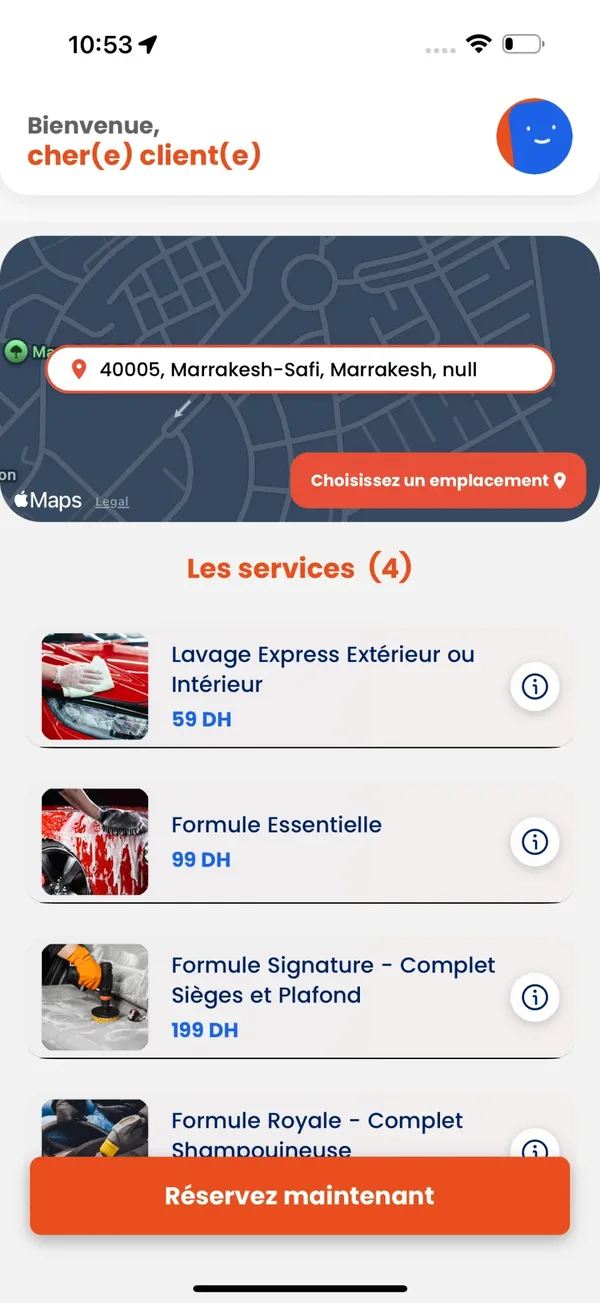
Cash or card, receipt, two-way ratings, incident reports. It’s the chain WashMinute already connects between customer and washer: request, acceptance, route on the map, job done, rating.
The inDrive model lets the rider propose a fare and drivers respond. It takes more logic and more safeguards than a calculated fare. A common middle ground: a suggested fare the rider can adjust within a range.
| Criterion | Calculated fare | Fare offers |
|---|---|---|
| Who sets the price | The platform: base fare, distance, time, zone | The rider proposes; drivers accept or counter |
| What the app must handle | Fare table, minimum fare, zone or time-of-day surcharges | Real-time offers, expiry timers, price floor, choosing between offers |
| Risks | Poorly calibrated fares at launch | Underpaid rides, long waits, abuse |
| Best for | Regulated-fare services, transfers, shuttles | Markets where fares are unregulated |
If your service has regulated fares, the fare-offer mode may be ruled out: check with your legal advisor.
Launch in one city, in one zone, for one use case, such as airport transfers or a company’s shuttles. Recruit drivers before opening the app to riders: a rider who sees no cars doesn’t come back.
| Part | Version 1 | Later |
|---|---|---|
| Rider | Booking, estimate, tracking, cash, rating | Saved cards, scheduled rides, promo codes |
| Driver | Sign-up, documents, rides, navigation, balance | Bonuses, targets, detailed stats |
| Fares | Calculated or suggested fare | Fare offers, dynamic surcharges |
| Back office | Driver approval, live tracking, support | Advanced dispatch, multi-city, financial reports |
| Safety | Trip sharing, SOS, masked numbers | Automated identity checks |
A ride-hailing product combines two mobile apps and a back office, so it’s priced on a custom quote, with a detailed proposal after the discovery call. As a reference point, our mobile apps start at 30,000 MAD and a mobile MVP typically takes 10 – 16 weeks. Cost depends mainly on the fare model, dispatch level, payments, languages (including right-to-left Arabic) and integrations.
Our projects that apply here:
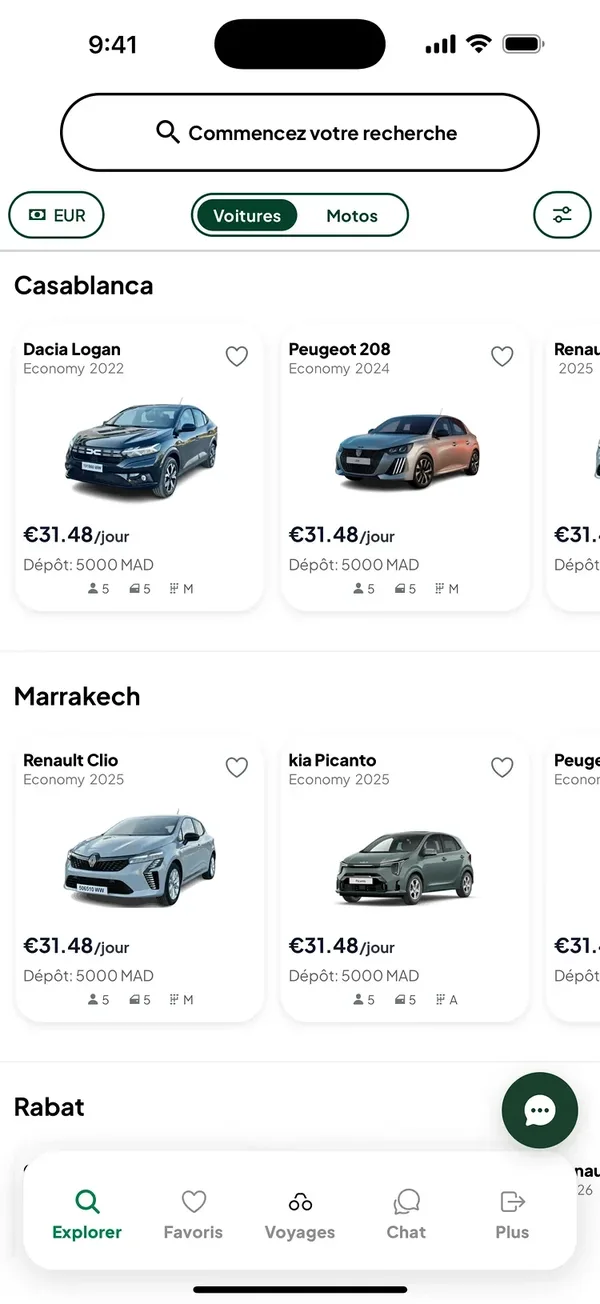
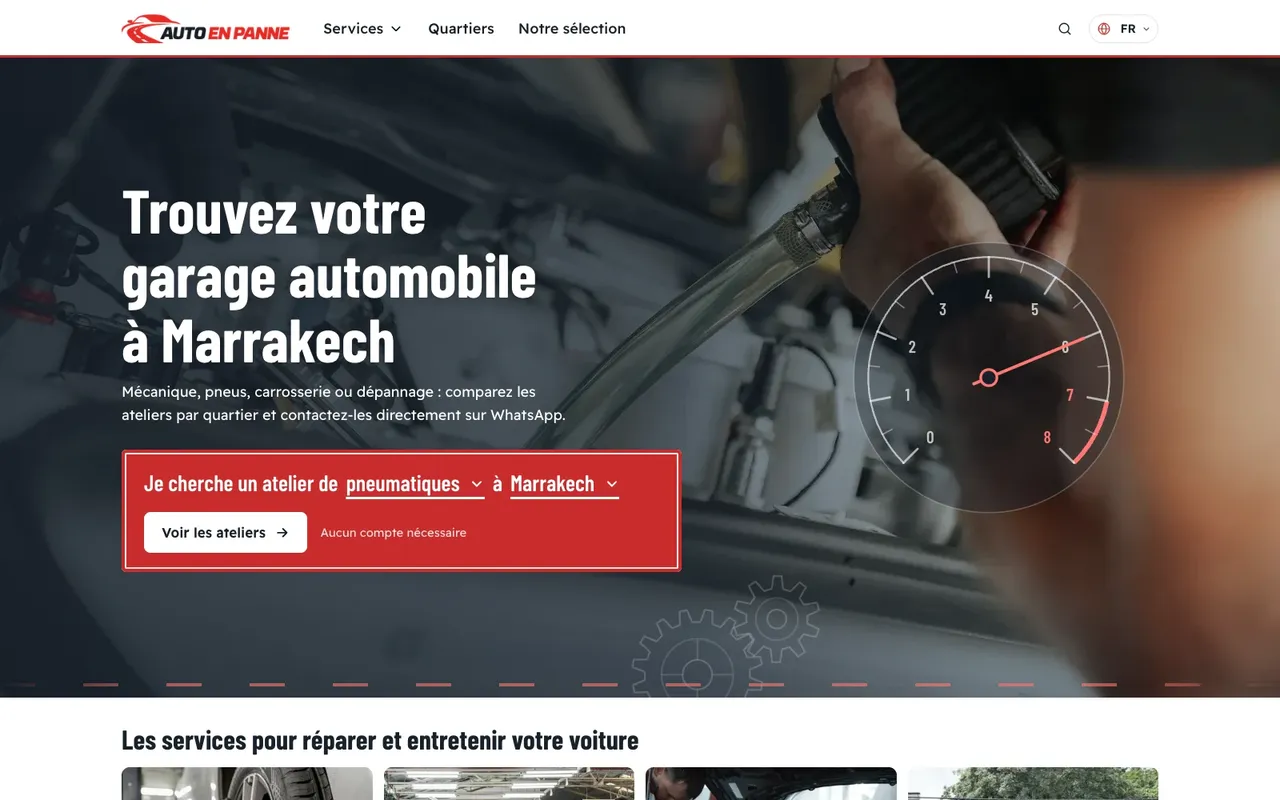
Real projects, with their screens and their status.
According to Hespress, in April 2025 the Interior Ministry maintained that only licensed taxis may provide urban passenger transport, including through an app; a framework for platforms is under study. As things stand, a service using private drivers falls outside that framework. We’re not lawyers: have your model reviewed by a lawyer before development, and again before launch.
It’s priced on a custom quote because it includes two mobile apps and a back office; as a reference, our mobile apps start at 30,000 MAD. Fare offers, automatic dispatch and card payments raise the cost; calculated fares and simple dispatch lower it.
A mobile MVP typically takes us 10 – 16 weeks; for two apps and a back office, the schedule is set after discovery. We work in two-week sprints, with a demo every week and a test build on your phone every sprint.
Yes. A booking and dispatch app for a licensed taxi operator or fleet is the use case that best fits the position the ministry expressed in 2025. If fares are regulated, the app shows an estimate rather than a free price. The rules for your service still need your legal advisor’s review.
We recommend it. The driver app needs background location, a sign-up flow with documents and screens riders should never see. Each is built with React Native and Expo, one codebase for iOS and Android; the back office runs on the web.
Yes: languages, currency and payment providers adapt to each country; Cardnd already shows prices in MAD or EUR. Our offices in Casablanca, Rabat, Marrakech and Ottawa cover Europe, Africa and North America. Passenger transport rules differ by country, so local legal advice is essential.
You do. Code, designs and intellectual property are handed over with documentation, access and training for your team. We sign an NDA before discussing the details.
Tell us about your service, your city and your drivers. We reply within 24 hours to set up a free discovery call; in parallel, get your legal advisor’s view.