Assistant on your documents
Procedures, contracts, catalogs, data sheets: your teams ask a question and get an answer that cites your own documents.
Service · RAG · agents · voice · Morocco
From our offices in Casablanca, Rabat and Marrakech, we build AI assistants, agents and automations connected to your documents and tools, each aimed at one specific process with a gain you can measure. Every system is evaluated before go-live, kept in check by guardrails, and reviewed by a person whenever a decision depends on it. A focused assistant typically takes 6 to 10 weeks; projects are custom-quoted after a free discovery call.
Start a project →See pricing →
Useful AI starts with a specific task, repeated often, whose cost you know. The use cases we build:
Procedures, contracts, catalogs, data sheets: your teams ask a question and get an answer that cites your own documents.
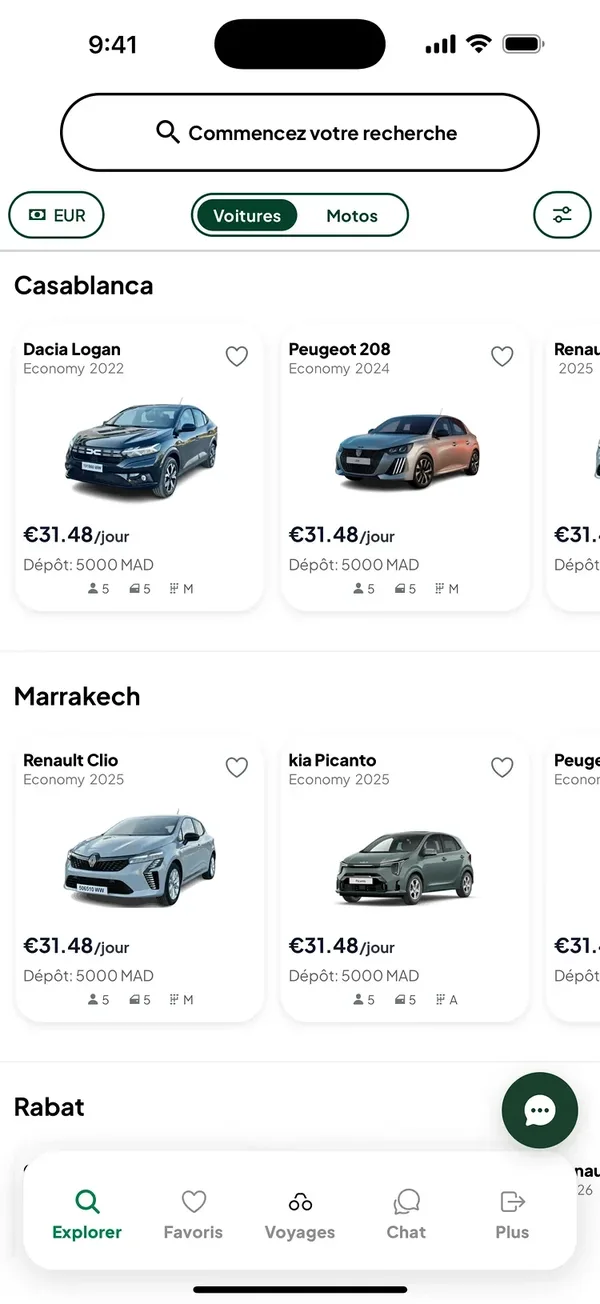
An assistant that handles frequent questions and hands off to a person at the right moment. Cardnd includes a support assistant alongside customer ↔ agency chat.
HireSense runs written or voice interviews, scores answers against a rubric with supporting evidence, and writes a report reviewed by a human.
Read invoices, delivery notes or files, extract the useful fields and file them in your software, with a review step when confidence is low.
Transcribe calls or interviews, turn them into a structured summary and send it to your CRM.
Multi-step tasks: check an order status, draft a reply, update a record. With limited permissions and a log of every action.
Before you commit a budget, we put numbers on it. That’s the deliverable of our “Choosing and integrating AI” advisory: costed use cases and a prototype.
With your teams: who does what, how many times a week, how long it takes, what goes wrong.
Time saved, response time, errors avoided: each use case gets an estimate, weighed against the cost to build and run it.
A prototype on a sample of your documents, with personal data masked, to check that the quality is there.
Real questions and cases with the expected answer. It measures quality before go-live, then after every change.
A group of users, checked answers, collected feedback. We widen the rollout when the numbers hold.
Monitoring, running costs, answer quality and a monthly report.
RAG (retrieval-augmented generation) means the assistant first searches your documents, then writes its answer from the passages it found, citing its sources. The model doesn’t need retraining: when a document changes, the answer changes.
Quality depends less on the model than on the preparation: splitting documents cleanly, keeping tables readable, respecting access rights (a salesperson has no business reading payslips) and being able to say “I don’t know” when the information doesn’t exist. That’s where most of the work goes.
A language model can be wrong with total confidence. We treat it that way:
HireSense shows how we build AI that touches sensitive decisions. The assistant runs the interview in writing or by voice, with a text fallback; it scores answers against a rubric, backed by evidence, and produces a structured report. Personal data is masked and a person reviews before any decision. It works in French, English and Arabic, and integrates with an ATS (applicant tracking system).
An assistant on its own does little. We connect it to your CRM, ATS, help desk or business software, so it reads the right data and puts its work where your teams already are.
We work with models from Anthropic (Claude), OpenAI and Mistral, and choose per task: quality in French and Arabic, speed, cost per request, data constraints. The architecture lets you switch models; the evaluation set tells you whether the new one does better.
A focused assistant, built on a well-defined process and set of sources, typically takes 6 to 10 weeks, prototype and evals included. Projects are custom-quoted. Also plan for a monthly running cost (model calls, hosting, document search) that varies with volume: we estimate it before building, then track it in the monthly report.
Real projects, with their screens and their status.
It’s custom-quoted, based on the number of sources, the integrations and the level of control you need. There are two budget lines, the build and a monthly running cost that varies with volume. Both are estimated in the detailed proposal sent after a free discovery call.
We choose the provider and configuration based on your constraints, including zero data retention options. Personal data can be masked before anything is sent, as in HireSense. And we sign an NDA before you show us a single document.
Yes, and you have to plan for it. We measure quality on a set of real cases before go-live, limit answers to approved sources and have a person review anything that leads to a decision. A mistake should be detectable and fixable, not hidden.
Yes: HireSense, for example, runs its interviews in French, English and Arabic. But a model’s quality varies by language and type of text, so we measure it language by language in the evals, on your own documents, before go-live.
No. A RAG assistant relies on the documents you already have, with no model retraining. What matters is that they’re current and consistent: part of the project is often sorting them and deciding who keeps them up to date.
Yes, that’s what makes it useful. The assistant reads the data it needs and writes its output where your teams already work: a customer record, a ticket, a candidate file. HireSense, for example, integrates with an ATS.
The architecture lets you move to another model. The evaluation set then checks, with numbers, that quality holds before you switch.
Describe it in a few lines. We reply within 24 hours to set up a free discovery call, then send a detailed proposal with options.