Purchasing & inventory
Purchase orders, stock by site or warehouse, a supplier portal and material prices tracked live.
Service · ERP & internal tools · Morocco
We build custom software and ERP systems for Moroccan companies that have outgrown their spreadsheets: purchasing, inventory, invoicing, HR, job sites or fleet, in a single system. Every module shares the same data, with role-based access and hosting in Morocco if required. Projects typically take 12 to 20 weeks, delivered in phases, and are custom-quoted after a free discovery call.
Start a project →See pricing →
Excel is a great tool to get started. It becomes a risk when the company grows and several people enter the same information in several places.
We don’t sell a software package to configure: we build the modules you need, and only those. Information entered once flows everywhere. At 2STM, when a contract is won, fleet assignment and materials purchasing kick in automatically.
Purchase orders, stock by site or warehouse, a supplier portal and material prices tracked live.
Quotes, invoices generated from project data, payment tracking and cash flow.
Employee records, assignments, hours, payroll, and CNSS and AMO filings produced straight from the platform.
Daily reports, photos, signatures and incidents on mobile, even with a patchy connection.
Bid preparation and costing, award, execution tracking and settlement, with a record of every cost assumption.
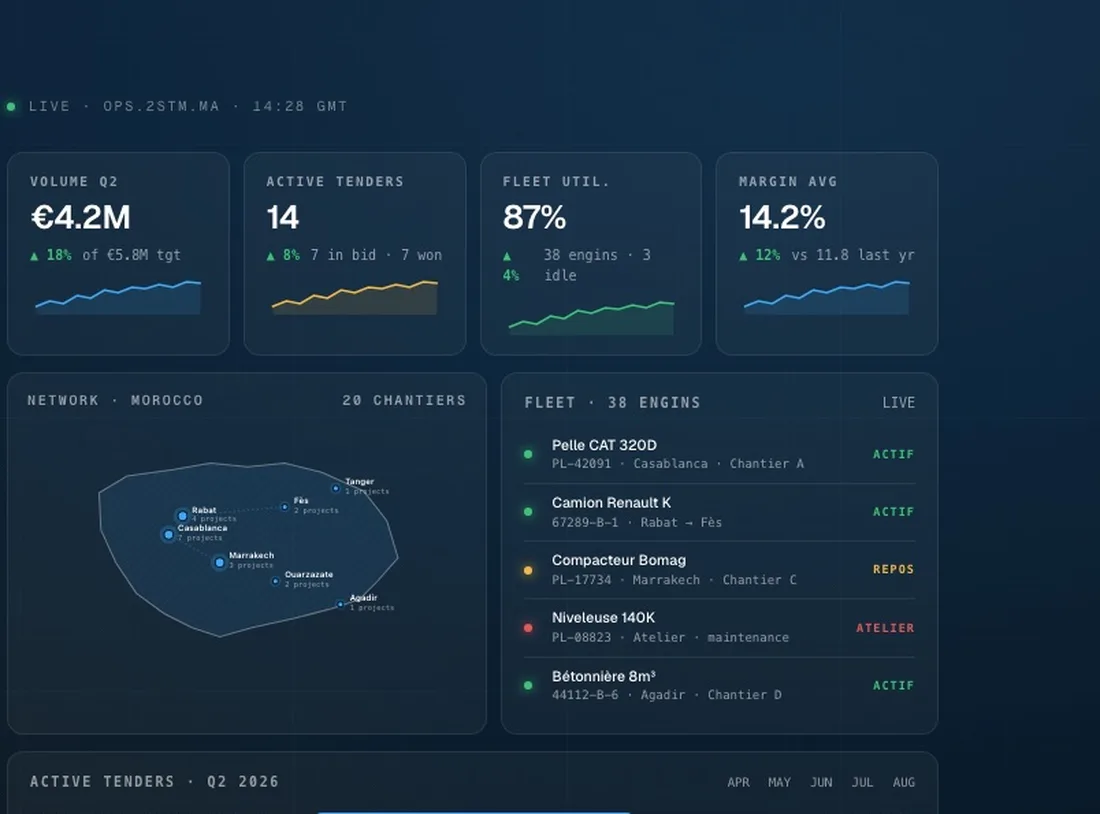
Executive dashboards, margins by project and alerts when a threshold is crossed.
Custom isn’t always the right answer. If your processes are standard, an off-the-shelf ERP will often be faster to roll out. Custom software makes sense when the way you work is your edge, or when no tool covers it without workarounds.
| Criterion | Off-the-shelf ERP | Custom software |
|---|---|---|
| Standard processes (accounting, simple inventory) | Often the right choice | Rarely justified |
| Processes specific to your trade | Costly customization, or workarounds in Excel | Built around your real workflows |
| Getting started | Fast if you adopt the standard | 12 – 20 weeks, in phases |
| Costs over time | Licenses and setup, often per user | Development, then hosting and maintenance |
| Ownership | A license to use | You own 100% of the code and IP |
| Roadmap | Set by the vendor | Set by your priorities |
Often the best answer is hybrid: keep your accounting software and build what’s missing around it, connected by API.
Workshops with the people who do the work, not just management. At 2STM, this first phase with the operations team surfaced 14 manual processes that could be automated.
Customers, projects, stock, people: each record exists once, and every module plugs into it.
Field, admin, finance, management: everyone sees and edits what concerns them.
We ship what hurts most first. At 2STM: bids and invoicing, then fleet, materials and the supplier portal.
Your existing files imported and cleaned, checked with your teams before the switch.
Documentation, access and user training, then a monthly report if we handle maintenance.
Business software holds your numbers, your payroll and your contracts. Security is part of the data model from day one, not bolted on at the end.
Your software has to talk to what already exists: accounting software, an ERP already in place, business tools or partner APIs. We connect systems instead of making you re-enter everything.
For management, dashboards show volume, margins, cash flow or equipment status live. And when a repetitive task lends itself to it, an AI component can be added: HireSense, our interview assistant in pilot, integrates with an applicant tracking system (ATS) and produces reports reviewed by a human.
For a public works group running 20 job sites across 7 cities, we built the system that brings together tenders, job sites, fleet, materials, payroll and accounting. The platform is in production, with 24 months of ongoing support to date.
| Metric | Before | After |
|---|---|---|
| Bid preparation | 5 days on average | 3 days (−40%) |
| Monthly invoicing | A week of manual work | Same day |
| Fleet availability (38 machines) | Gaps in the schedules | +24% |
| CNSS, AMO and payroll filings | Separate ledgers | 100% generated by the platform |
| Tools | 6 disconnected tools | 1 platform |
Real projects, with their screens and their status.
It’s custom-quoted, because it depends on the number of modules, roles and integrations, and on the volume of data to migrate. Phased delivery lets you fund the highest-return module first. The detailed proposal, sent after a free discovery call, prices the project phase by phase.
A complex web application typically takes 12 to 20 weeks; the exact schedule is set after discovery. Because we deliver in phases, your teams use the first module before the last one is finished, and you see a demo every week.
Not necessarily. If it does its job, we build around it and connect it by API or import/export. The goal is to eliminate re-entry, not to replace everything on principle.
Yes, if your clients, your contracts or your internal rules require it. For 2STM, the infrastructure includes a server in Morocco and automated backups, to meet data residency requirements.
Yes. We add mobile views that work offline and sync when the network comes back. On 2STM’s job sites, daily reports, photos, signatures and incidents are entered on mobile, even with a patchy connection.
Your choice. Our maintenance and enhancement plan covers monitoring, fixes and new modules, with a report every month. You can also take the software in-house: you own the code, and the handover includes documentation, access and training.
We reply within 24 hours to set up a free discovery call, under NDA. You then receive a detailed proposal: scope, timeline and price, with options.