Your bank’s subsidiary
The simplest route if your business account is already there. Still compare it with a second offer: it is no longer the only option.
Guide · Online payments · Updated November 2026
To accept cards online in Morocco, you need a contract with an acquirer licensed by Bank Al-Maghrib, then a technical integration with its payment gateway. Since CMI’s monopoly ended, that contract is signed with a bank subsidiary or a payment institution, and CMI processes payments on their behalf. Here is the application, the fees, the integration, Apple and Google rules for apps, and the alternatives that work in Morocco.
Start a project →See pricing →
The acquirer is the licensed bank or payment institution that signs the acceptance contract with you, pays out your sales and takes its fee. The gateway is the technical layer: the secure payment page and the interface your website or app calls.
CMI (Centre Monétique Interbancaire) long combined these roles. Under Competition Council decision no. 152/D/2024, it has signed no new merchant contracts since 1 November 2024, and licensed payment institutions and bank subsidiaries have been selling acquiring services since 1 May 2025 (Council statement reported by Maroc.ma). According to Bank Al-Maghrib’s 2025 banking supervision report, Morocco had about ten acquirers at the end of 2025, up from three in 2024; the transfer of CMI’s merchant portfolio was completed in April 2026, and CMI is now a technical processing platform working for third parties.
| Party | Role | For you |
|---|---|---|
| Acquirer | Contract, fee, payouts | You apply to it and negotiate fees with it |
| CMI | Technical platform working for acquirers | Its name stays in technical documents, but you no longer sign with it |
| Customer’s bank | 3-D Secure, then approval or decline | According to CMI, it checks the security code, balance, limits and risk |
Had a CMI e-commerce contract? It should have been transferred to an acquirer: check your statements to see who your new contact is.
CMI now refers online merchants to its partner acquirers: Al Filahi Cash, Attijari Payment, CDM Pay, Damane Cash, Lana Cash, M2T (Chaabi Payment) and Saham Paiements. Your bank may present its own offer, but you remain free to choose your acquirer, the Competition Council points out.
The simplest route if your business account is already there. Still compare it with a second offer: it is no longer the only option.
A payment institution on Bank Al-Maghrib’s list. Naps ePay gateway, payment links, and prices published online.
Morocco is not among the countries where Stripe opens business accounts: Stripe only works for a company established in a supported country.
Each acquirer has its own forms; those published by CMI give a good idea of what you will be asked. CMI affiliated self-employed individuals and businesses headquartered in Morocco; Naps requires a company or auto-entrepreneur status.
Our advice: apply with a website that is already live, prices in dirhams, terms of sale and a clear delivery and refund policy.
Few acquirers publish their prices. Two benchmarks can be verified.
Bank Al-Maghrib’s regulatory decision no. 265/W/2026, in force since 1 October 2026, caps domestic interchange, the share paid to the customer’s bank, at 0.50% excl. VAT, and at 0.15% for online government services and physical local shops. It does not cover foreign cards and does not set your own fee, which adds acquiring and operating costs. It also forbids passing that fee on to the customer.
Naps displays its prices (November 2026, excl. VAT, subject to conditions, excluding authentication fees):
| Naps, excl. VAT | e-Go pack | e-Premium pack |
|---|---|---|
| Fee, Moroccan cards | 1.68% | 1.68% |
| Fee, international and premium cards | 3% | 3% |
| Setup | 6,900 MAD | 29,900 MAD |
| Annual subscription | 2,900 MAD, free in year one | 5,900 MAD, free in year one |
From other acquirers, ask in writing for: fees on Moroccan and foreign cards, fixed costs, authentication fees, guarantee amount, payout delay, and the cost of a refund and of a disputed payment.
According to CMI’s e-commerce brochure, the customer is redirected to the secure payment page, enters their card, their bank authenticates them (3-D Secure) then approves or declines, and the result comes back to you. The card is entered on the platform, PCI-DSS certified according to CMI, never on your server; every exchange is signed with a hashing algorithm and a secret key. Here is how we build that flow.
The total is recalculated from the catalogue (products, delivery, deposit) and the order created before the redirect. The price shown in the browser is never trusted.
Amount, currency, order number and return URLs, signed on the server. With CMI, the page can carry your branding, in Arabic, French and English.
The order becomes “paid” only after the signature, amount and order number sent by the gateway have been checked. The customer reaching the thank-you page is not proof.
A notification can arrive twice: order, stock and receipt must be handled only once.
According to CMI, the site receives an integration kit and test access, then goes live once testing is approved. Test declined payments, failed 3-D Secure, abandonment and refunds.
CMI strongly advises enabling 3-D Secure (a code received by SMS). Its platform also handles pre-authorisation, cancellation and partial refunds. No website? A payment link is enough: PaybyMail with CMI, Naps ePay Link.
It all depends on what you sell. Under rule 3.1.3(e) of the App Store Review Guidelines, an app selling physical goods or services consumed outside the app must use a method other than in-app purchase, such as Apple Pay or card entry. Rule 3.1.1, by contrast, requires in-app purchase to unlock content or features inside the app. Google Play’s Payments policy mirrors this: Google billing is required for digital items and must not be used for physical goods and services (transport, cleaning, food delivery, tickets).
| The app sells | Payment | Rule |
|---|---|---|
| Delivered products | Card through your acquirer, cash on delivery | Apple 3.1.3(e) · Google Play |
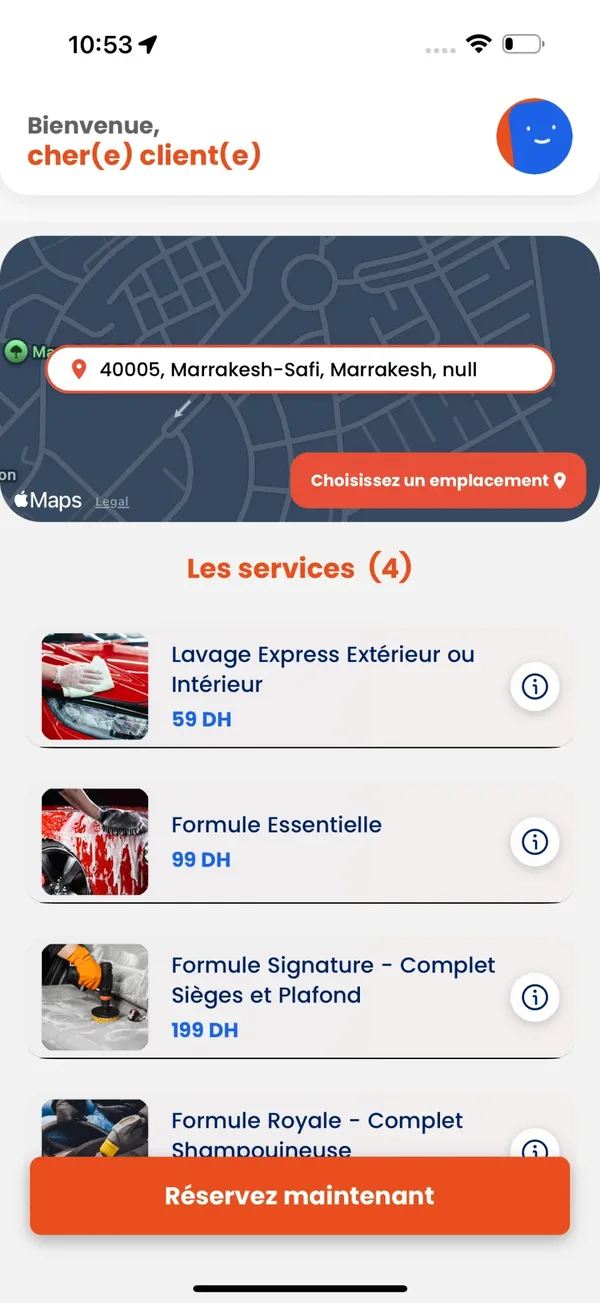
| Services outside the app: rides, car wash, rentals, delivery | Card through your acquirer, deposit, payment on site | Apple 3.1.3(e) · Google Play |
| Live one-to-one service (lessons, consultations) | Methods other than in-app purchase allowed by Apple | Apple 3.1.3(d) |
| Subscriptions, premium content, features, virtual credits | Apple in-app purchase, Google Play billing | Apple 3.1.1 · Google Play |
A delivery, ride-hailing or rental app therefore collects through CMI or Naps with no store commission. An app selling a digital subscription cannot collect it that way.
According to ANRT’s ICT survey (2024 data), as reported by Hespress, 24.9% of Moroccans bought something online, and more than eight in ten of those buyers pay cash on delivery. Accepting cards only means losing a large share of customers.
Confirmation by phone or WhatsApp before shipping, the exact total shown, and tracking of the cash collected by the courier.
For bookings, rentals and custom orders: the card secures the commitment, the balance is paid on handover.
For selling on Instagram, WhatsApp or by phone without a website, through the acquirer’s secure page.
For business-to-business sales and large amounts, with a mandatory order reference in the transfer label.
You don’t need a foreign provider to sell abroad: CMI accepts the major international networks (Visa, Mastercard, American Express, UnionPay, JCB, Diners Club, Discover) and Naps international Visa and Mastercard cards, at a higher fee (3% excl. VAT at Naps).
The other way round, a Moroccan customer paying a foreign website uses an international card, within their e-commerce allowance: 20,000 MAD a year for a resident individual, according to the Office des Changes’ 2026 General Instruction on Foreign Exchange Operations. To sell in Morocco, a Moroccan acquirer is therefore the right choice.
Cards, cash on delivery, deposits: before development, based on what you sell and the store rules.
As soon as development starts: it is the step your developer cannot speed up. Naps says its review usually takes 24 business hours; elsewhere, ask for the timeline.
With the kit and signing key, in your company’s name: server-side amount, hosted page, notification, statuses, refunds.
Once the acquirer approves testing: one real small payment, its refund, then reconciliation against the statement.
For an app, add the store review time: see our guide to publishing on the App Store and Google Play.
We integrate CMI or Naps into websites and apps, and Stripe when the business has access to it. We recommend signing the merchant contract in your company’s name; we handle integration, testing and go-live.
Real projects, with their screens and their status.
Not directly: since 1 November 2024, CMI no longer signs new merchant contracts (Competition Council decision no. 152/D/2024). You sign with an acquirer; CMI acts as the technical platform.
It depends on the acquirer. Naps lists 1.68% excl. VAT on Moroccan cards, 3% excl. VAT on international cards, a 6,900 MAD setup fee and a 2,900 MAD annual subscription excl. VAT, free in year one (e-Go pack). For the others, ask for a written offer.
You need a registered business: trade register and patente with CMI, a company or auto-entrepreneur status with Naps. We recommend the contract be in your company’s name, not your developer’s.
Not with a Moroccan company: Morocco is not on Stripe’s list of countries. It is an option for a company established in a supported country.
Only for digital items used in the app. For delivered products or services outside the app, Apple (rule 3.1.3(e)) and Google Play require another method: cards through your acquirer or cash on delivery.
No. Under Bank Al-Maghrib decision no. 265/W/2026, the merchant’s fee may under no circumstances be billed to the payer. Build it into your prices.
Mostly the time the application takes: Naps says usually 24 business hours, other acquirers give their timeline on request. Integration moves forward in parallel in the test environment.
Tell us what you sell, to whom, and the payment methods you have in mind. Reply within 24 h with our advice, then a detailed proposal after the discovery call.